Larch Creek Birds
What the birds (and frogs) are saying at a creek in western Washington

Bird
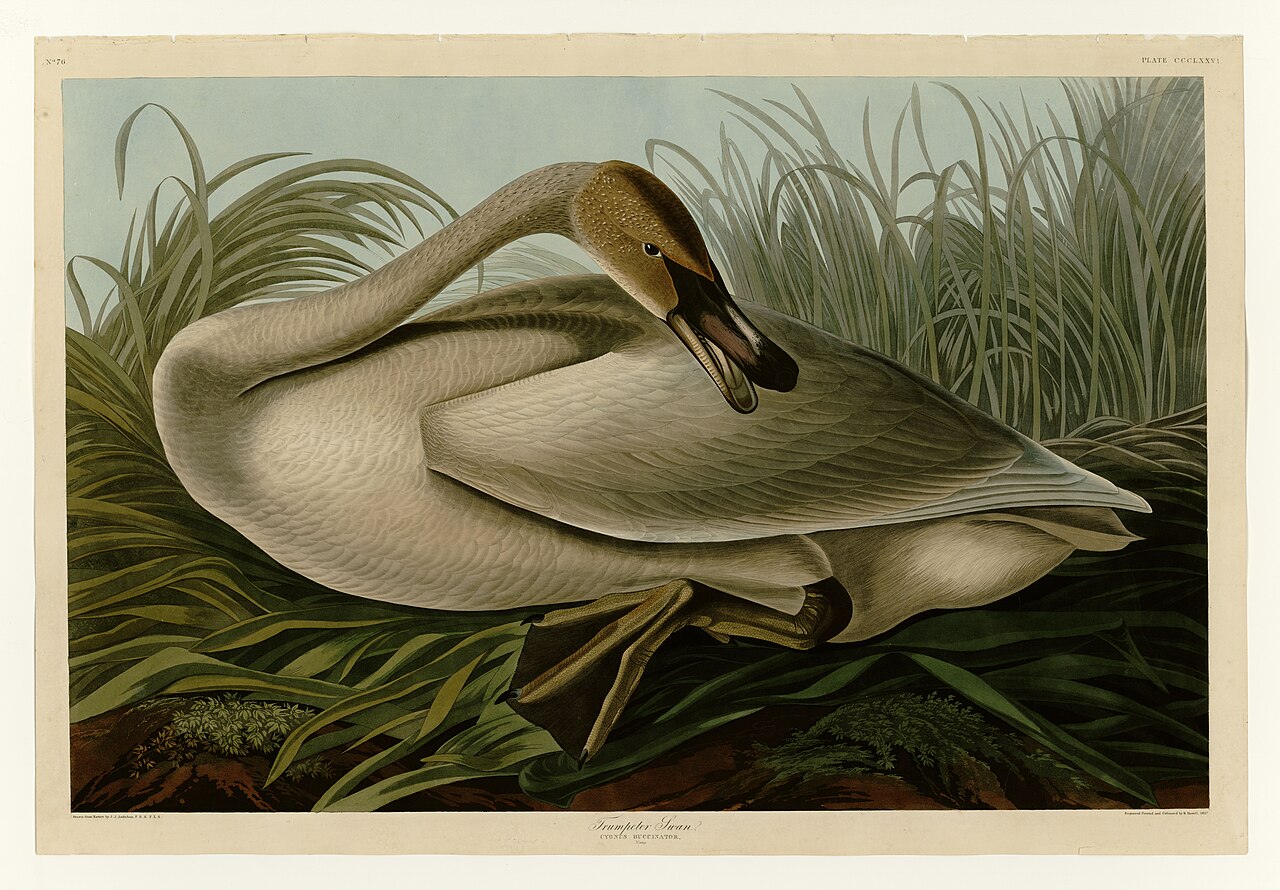
Trumpeter Swan
Cygnus buccinator
Ducks, Geese, and Waterfowl (Anatidae)
In for the season
Winter visitor. Expected here roughly Aug to Jun. In for the season: expectation was 72% a month ago, 90% now.
- Field marks
- An enormous all-white swan with a straight black bill and no yellow at its base; swims with the neck straight and kinked at the bottom, like a question mark that has given up.
- Male & female
- Alike; the male (the cob) is larger.
- Voice
- A deep, resonant, trumpet-like honk, lower than the Tundra Swan's high whoop. A flock overhead sounds like a brass section tuning up in another building.
- Diet
- Aquatic plants and tubers, and grain in winter fields.
- Habitat
- Breeds in Alaska and Canada; winters in the Skagit and other river valleys of western Washington.
- Nesting
- A mound of vegetation at a lake edge, 6 ft across; 4–6 eggs.
- Size
- Wingspan 7–8 ft, up to 28 lb: wider than your car and the weight of a three-year-old, airborne. North America's heaviest flying bird, which it manages by being mostly neck.
Arrives in October–November from the north and stays until March, so calls overhead now are flocks coming in for the winter. In the 1930s fewer than 70 were known in the lower 48; there are now tens of thousands, one of conservation's quieter triumphs.
Season how expected it is here, week by week
At the creek 13 calls on 2 days, first Oct 29, last Oct 31
Recordings
Clearest recording · Oct 31 10:41 am · 94% sure

Recent · Oct 31 4:31 pm · 88% sure

Recent · Oct 31 1:45 pm · 87% sure

Recent · Oct 31 11:26 am · 88% sure

From the encyclopedia
The trumpeter swan, or simply the trumpeter, is a species of swan found in North America. The heaviest living bird native to North America, it is also the largest extant species of waterfowl, with a wingspan of 185 to 304.8 cm. It is the American counterpart and a close relative of the whooper swan of Eurasia and has even been considered the same species by some authorities. By 1933, fewer than 70 wild individuals were known to exist; extinction seemed imminent until aerial surveys discovered a Pacific population of several thousand trumpeter swans around Alaska's Copper River. Careful reintroductions by wildlife agencies and the Trumpeter Swan Society gradually restored the North American wild population to over 46,000 birds by 2010.
From Wikipedia, "Trumpeter swan", CC BY-SA 4.0.