Larch Creek Birds
What the birds (and frogs) are saying at a creek in western Washington
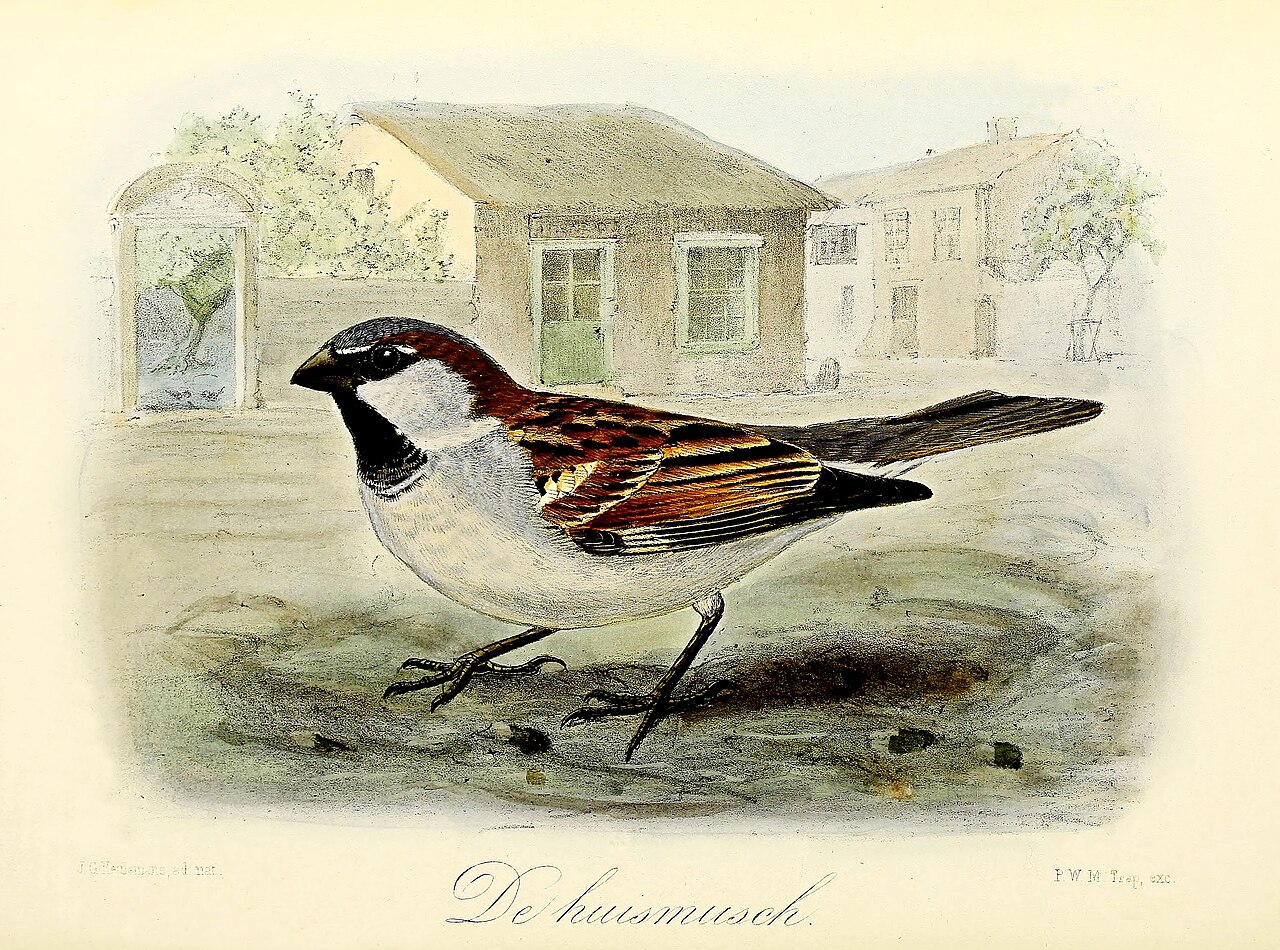

Bird
House Sparrow
Passer domesticus
Old World Sparrows (Passeridae)
Year-round resident. Expected at the creek in every month.
- Field marks
- A chunky brown sparrow; the male has a grey crown, black bib and chestnut nape, the female is plain buff-brown with a pale eyebrow.
- Male & female
- Strongly different: only the male has the black bib and grey cap.
- Voice
- Monotonous 'cheep' and 'chirrup' from ledges and hedges.
- Diet
- Seeds, grain, scraps, dropped fries, and insects for the chicks.
- Habitat
- Towns, farms and buildings; rarely far from people and almost never in deep forest.
- Nesting
- In any cavity: eaves, vents, signs, nest boxes; several broods a year.
- Size
- 6 in long, about 1 oz: six quarters, found wherever people drop fries.
Brought from Europe in the 1850s and now on every continent except Antarctica, which it is presumably considering. Still unlikely at a forested creek, so the few calls here are worth a second listen.
Season how expected it is here, week by week
At the creek 4 calls on 2 days, first Oct 29, last Oct 31
From the encyclopedia
The house sparrow is a bird of the sparrow family Passeridae, found in most parts of the world. It is a small bird that has a typical length of 16 cm (6.3 in) and a mass of 24–39.5 g (0.85–1.39 oz). Females and young birds are coloured pale brown and grey, and males have brighter black, white, and brown markings. One of 28 species in the genus Passer, the house sparrow is native to most of Europe, the Mediterranean Basin, and a large part of Asia. Its intentional or accidental introductions to many regions, including parts of Australasia, Africa, and the Americas, make it the most widely distributed wild bird.
From Wikipedia, "House sparrow", CC BY-SA 4.0.